Send money from Norway to India: complete guide
Everything you need to transfer money from Norway to India securely, faster, and at the best exchange rates. Compare banks, money transfer apps, and business payment platforms on cost, speed, and compliance.


Best ways to send money to India: bank, app, wire & cash
There are five main ways to send money from Norway to India: online transfers, mobile transfer apps, bank wires, cash pickup, and FX brokers. Online transfers and apps carry the lowest cost at 0 to 0.5 percent FX markup, while bank wires are the most expensive at 3 to 4 percent plus fees.
Bank WireSWIFT Transfer | Online TransferXflow, Xe, Remitly | Debit / Credit Card | Cash PickupWestern Union, MoneyGram | OtherFX broker, crypto | |
|---|---|---|---|---|---|
| Speed | 3–5 business days | Up to 4 days | 1–2 days | Same day | Varies |
| Typical fees | NOK 200 – 350 | Free – NOK 50 | NOK 0 – 100 | NOK 50 – 150 | Varies |
| FX markup | 3 – 4% | 0 – 0.5% | 0.5 – 1.5% | 2 – 3% | Varies |
| KYC required | Yes | Yes | Yes | Partial | Varies |
| Best for | Large amounts | Recommended | Smaller amounts | Unbanked recipients | High complexity |
Total INR delivered per 10,000 NOK sent, by provider
Check how much it costs to send money from Norway to India and compare the final INR amount delivered across providers. Note: Rates are indicative and may change based on live market rates and the Xflow plan you select.



Xflow vs Wise vs Western Union vs banks: sending money from Norway to India
Here is how the most popular ways to send money from Norway to India compare on rate, speed, fees, and limits. Xflow is built for lower margins and a transparent flat fee, with no transfer limit, while bank wires apply a 3 to 4 percent margin plus higher fees.
Xflow | Wise | Western Union | Bank Wire | |
|---|---|---|---|---|
| Exchange rate | Lowest margin | Mid-market (0%) | 0.5–3% margin | 3–4% margin |
| Transfer fee | NOK 0 | NOK 50–150* | NOK 0–30* | NOK 200–350 |
| Speed | 3–4 days | Instant–3 days | Minutes (UPI/cash)–3–5 days (bank) | 5–7 days |
| Transfer limit | No limit | High (verified account) | ₹200,000/transfer via UPI | No limit |
| Cash pickup |  | |  | |
| Business transfers | Native | Yes | Limited | Yes |
Why frequent senders prefer Xflow
Built for the Norway–India corridor. More INR, less friction, every time.
| Corridor Advantage | Xflow Benefit | Why It Matters |
|---|---|---|
| Lower FX margin | Built for cost efficiency | More INR than a traditional bank wire |
| No hidden fees | Transparent pricing | No surprises at checkout |
| Fast settlement | Typically 3–4 business days | Recipient gets funds sooner than a branch wire |
| 100% compliance | RBI-regulated rails | Valid FIRA documentation every time |
| Business & freelancer friendly | Built for service export payments | Handles FIRA, purpose codes, INR settlement |
| Dashboard | Multi-transaction overview | FX history — manage volumes at scale without manual reconciliation |
How to send money from Norway to India with Xflow
Xflow gives your business a dedicated receiving account, so your Norwegian clients pay you by SWIFT transfer, and you receive INR in your Indian bank account, usually within 3–4 business days, with a FIRA for every transaction.
01 | Create your account & complete KYC
Create your Xflow account and complete KYC (PAN, GSTIN, business proof).
02 | Get your NOK receiving details
Get your dedicated NOK receiving account details from Xflow — share these with your Norwegian client or payer.
03 | Your client sends the transfer
Your Norwegian client initiates a SEPA transfer in EUR, or a SWIFT transfer in NOK, to your Xflow account.
04 | Xflow converts to INR
Xflow converts and credits INR to your linked Indian bank account.
05 | Download your FIRA
Download your FIRA instantly from the Xflow dashboard for each transaction.
How much money is sent from Norway to India?
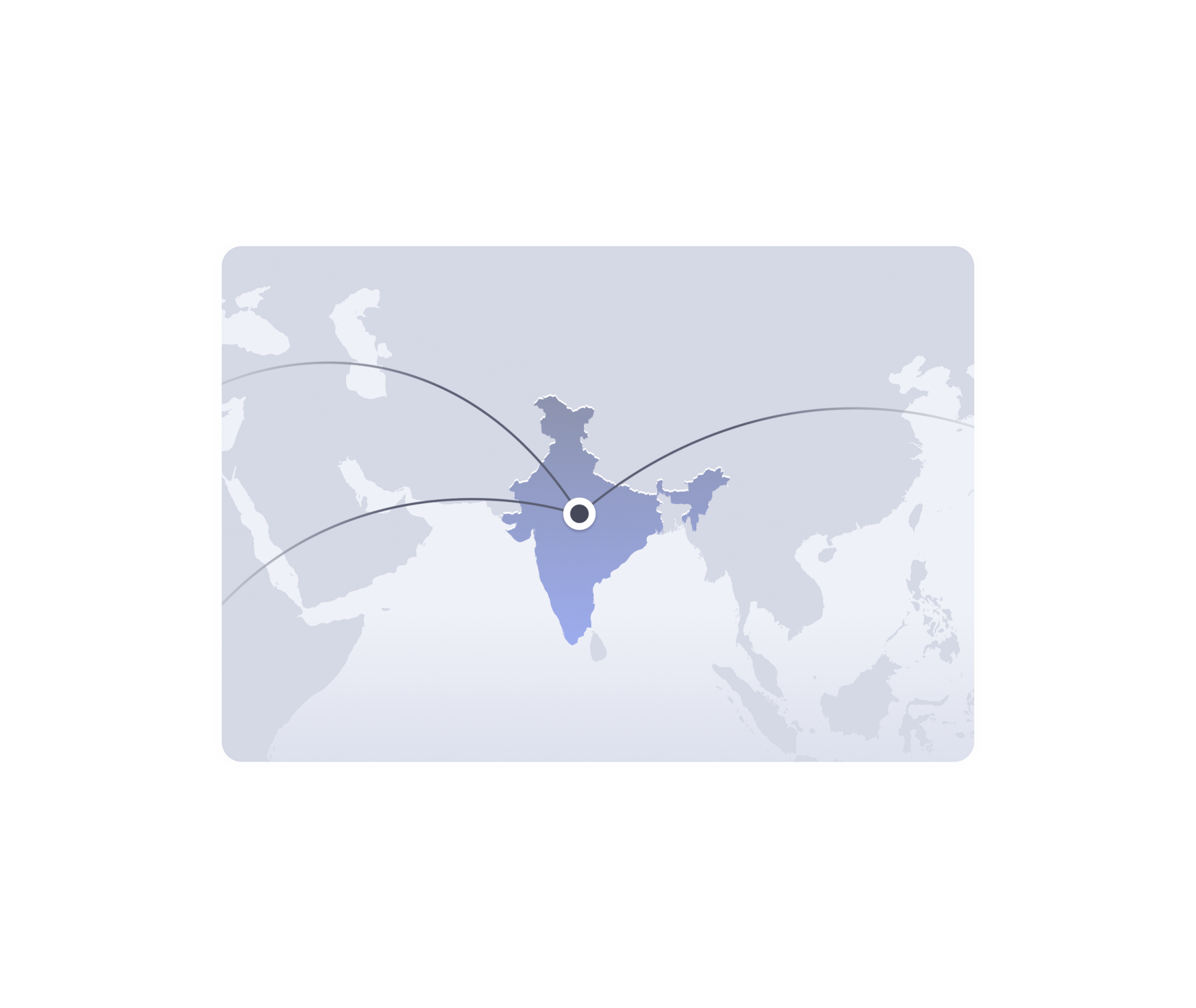
Norway is a source of inward payments to India, much of it driven by business and professional transfers. India received a record 129 billion dollars in remittances in 2024, reflecting deep commercial ties — a Norway-specific inbound figure isn't separately published by the World Bank or RBI, though Norway's oil services, maritime, and tech sectors sustain a steady flow of vendor and payroll payments into India.

Vendor & Contractor Payments
Norwegian oil & gas, maritime, and technology companies paying Indian engineering firms, software agencies, and service providers. High volumes, recurring transfers, compliance-heavy.
Freelancer & Remote Team Payroll
Norwegian startups and SMEs paying Indian developers, designers, and consultants. Speed and settlement documentation matter — delayed payments affect operations.
Subsidiary & Intercompany Transfers
Norwegian multinationals with Indian entities managing working capital, transfer pricing, or project-based funding across the India–Norway corridor. Regulatory accuracy is non-negotiable.
What to check before sending money from Norway to India
Five factors decide how much INR actually reaches your recipient: exchange rate markup, transfer fees, processing time, tax and reporting rules, and sending limits. Compare the exchange rate offered, not just the advertised fee, since the FX markup is usually the bigger cost.
- 01Exchange rate markups Norwegian banks add 2–4% over mid-market whereas most fintechs add 0.5–1%. This is where most of the cost hides.
- 02Transfer fees Norwegian bank SWIFT wires typically cost NOK 200–350+ per transfer. Fintech platforms charge significantly less. Always evaluate fee + FX spread together.
- 03Processing time Norwegian bank SWIFT wires take 2–5 business days; fintech platforms are typically 1–2 days or faster.
- 04NOK is not a SEPA currency Norway is part of the EEA but not the EU, and NOK is not a SEPA currency. All NOK to INR transfers route via SWIFT. Choose fintechs with efficient NOK/INR rails to minimise costs.
- 05TCS rules for Indian receivers TCS applies to outward LRS remittances from India — not to inward transfers from Norway. Recipients in India are not subject to TCS on funds received.
- 06Limits & KYC No legal cap on sending from Norway to India. Norway's Anti-Money Laundering Act (2018), supervised by Finanstilsynet, requires full KYC on all regulated platforms.
- 07Bank fees vs fintech fees Norwegian banks charge high FX spreads + SWIFT fees + potential correspondent bank deductions. Fintechs offer lower spreads and transparent fees with more INR delivered overall.
When is the best time to send money from Norway to India?
The best time to send money from Norway to India is when the rupee is relatively weak, so your recipient gets more rupees per krone. Send on weekdays for live-rate execution and set a rate alert to avoid month-end volatility.
- 01When INR is weak (higher NOK/INR) During krone strength — often correlated with high oil prices — the recipient gets more rupees per krone.
- 02When INR is strong (lower NOK/INR) During strong FII inflows or RBI support phases — less favourable for senders.
- 03Oil price–NOK correlation The Norwegian krone typically strengthens when global oil prices rise. Monitoring oil market sentiment can help time larger transfers favourably.
- 04Weekday vs. weekend FX markets are closed on weekends. Weekend transfers execute at queued rates with no visibility. Always send on weekdays for live-rate execution.
- 05How to avoid spread losses Set a target rate, use FX alerts, and avoid sending at month-end or quarter-end when volatility spikes.
How to save money when receiving from Norway to India
You can keep more of every payment from Norway by comparing total INR received, not just the fee, asking senders to use the cheaper funding method, consolidating payouts, and using the correct RBI purpose codes. These habits can save thousands of rupees a year.
- 01Compare FX markup, not just fees Total INR delivered is the only number that matters. A zero-fee transfer with a 3% spread costs more than a small fee at near mid-market rates.
- 02Watch the oil price–NOK correlation The Norwegian krone typically strengthens when oil prices rise. If you send large amounts regularly, tracking NOK against oil market sentiment can improve your timing.
- 03Avoid weekend transfers FX markets are inactive on weekends. Transfers initiated on Saturday or Sunday execute at stale rates with no live pricing.
- 04Set FX rate alerts For larger amounts, monitoring the NOK/INR rate and transferring at your target can meaningfully improve INR yield.
- 05Consolidate transfers where possible Each transfer carries fixed costs. Batching smaller payments into fewer, larger transfers reduces overall cost.
- 06Use purpose codes correctly Incorrect purpose codes delay settlement and FIRA issuance. Ensure your platform assigns the right RBI classification on every transaction.
- 07Choose RBI-regulated platforms Unregulated intermediaries carry settlement risk and may not issue valid FIRCs, creating compliance exposure down the line.
Tax & regulations for receiving money from Norway to India
Inward remittances into India are not taxed by default; tax depends on the nature of the income. Payments must arrive through authorised dealer channels with a purpose declaration, and India's TCS applies only to outward LRS transfers, not to money you receive. Norway has no outward transfer tax, but Finanstilsynet-supervised platforms must report cross-border transactions to Økokrim under AML rules.
- 01Norwegian outbound rules No legal cap on sending funds from Norway to India. All money transfer operators must be licensed and supervised by Finanstilsynet (the Norwegian Financial Supervisory Authority). Norway's Anti-Money Laundering Act (2018) requires KYC, ongoing customer monitoring, and reporting of suspicious transactions to Økokrim (Norway's financial crime authority).
- 02Norway and the EEA Norway is an EEA member but not in the EU. NOK is not a SEPA currency — all transfers to India route via SWIFT. Fintech providers registered in Norway or other EEA states can serve Norwegian senders under EEA passporting rules.
- 03RBI guidelines for inbound remittances Must arrive via authorised dealer (AD) channels. Purpose declaration required. INR credited at prevailing conversion rate.
- 04LRS considerations LRS governs outward remittances from India. Not applicable for Norway-to-India transfers.
- 05TCS & compliance TCS on remittances applies to LRS outflows from India only. Not applicable to inbound transfers from Norway.
- 06Bank reporting threshold Norwegian financial institutions report suspicious transactions to Økokrim under AML obligations — this is routine compliance, not a tax trigger. Tax treatment depends on the nature of the underlying transaction.
Send money to India from other countries
India is one of the world's top remittance destinations. See how the corridor looks from different sending countries and find the right guide for your route.